
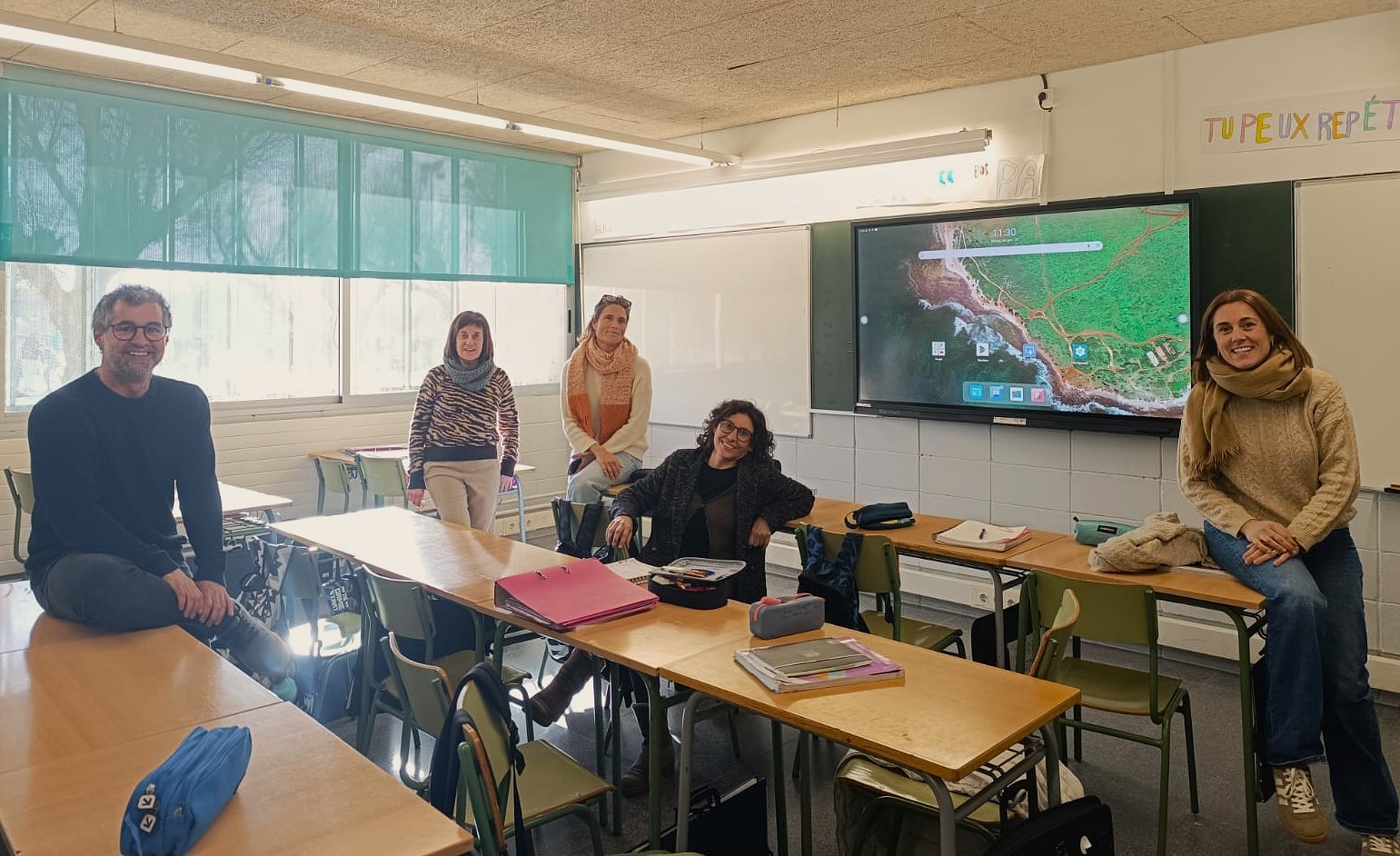
Marta Baret, Anna Juanola, Montse Lardin, Albert Ramos and Emma Clara teach biology and geology at the Institut Castelló d’Empúries (Girona). Their motivation for environmental topics and active learning methodologies has led them to participate in the LIFE ECOREST project’s educational programme for the past two years. They also work ‘with great enthusiasm’ on an environmental project in 1 ESO, have developed campaigns and have joined initiatives such as Let’s Clean Up Europe.
From your experience in the classroom, how much do students know about the marine environment?
Our students have a very basic and theoretical knowledge of the marine environment. From a pedagogical point of view, our goal is for our students to engage in an experiential, locally-sourced project, and that they could see, in a real-world context, the problems affecting marine ecosystems and the nearby ecological projects that are being developed. This gives their learning meaning and coherence with the work done in the classroom.
Are they interested in the protection and conservation of the marine environment?
Yes, in general, they are motivated generations who are aware of the need to preserve the environment.
In recent years, have you noticed an evolution in students’ awareness?
Yes, there has been a positive evolution since linking the curriculum objectives with the Sustainable Development Goals (SDGs), which are cross-curricular and are worked on in other projects such as those already mentioned. In this regard, digitalisation and social media also promote awareness and the dissemination of the entire environmental issue currently being experienced globally.
What kind of tools or resources are provided in the educational sphere to promote sustainability and care for the marine environment?
At our school, we have an interdisciplinary project in the first year of secondary school structured around the SDGs related to environmental conservation. It is implemented using the PBL (Problem-Based Learning) methodology and cooperative groups. The work on each of the goals is linked to a local project or initiative. In the case of SDG 14, life below water, we have participated on the LIFE ECOREST project.
How could we encourage young people to participate in marine conservation and ecosystem recovery? What actions or approaches do you consider most effective?
We believe that this can be achieved by empowering students to feel part of the project. In this sense, learning about the actions and protagonists of local environmental projects encourages them to take proactive initiatives, from a more micro level within the classroom to the idea of participating in local actions and the immediate environment.
What are the needs of teachers to improve education for sustainability and marine conservation?
In general, environmental education initiatives have improved significantly in recent years and have provided us with valuable tools to work on the subject beyond the classroom. We must continue to strengthen communication channels so that proposals such as those from LIFE ECOREST reach all schools.
How do you rate initiatives such as the educational programme developed within the framework of the LIFE ECOREST project?
The combination offered by LIFE ECOREST, with its environmental theme, real-life context and active approach, helps to achieve meaningful learning for our students.
What aspects of the LIFE ECOREST project caught your attention the most?
In addition to what has already been mentioned, the agility and fluidity in communication with the people who manage the project, as well as the quality of the activities and educational materials provided.
What would you improve or recommend for future educational activities in similar projects?
A good initiative would be to establish correspondence with groups of young people from other centres or countries involved in the project or similar ones. We should take advantage of the potential of networks so that our students can exchange experiences of this type and form a community to generate proactive trends in environmental management.