
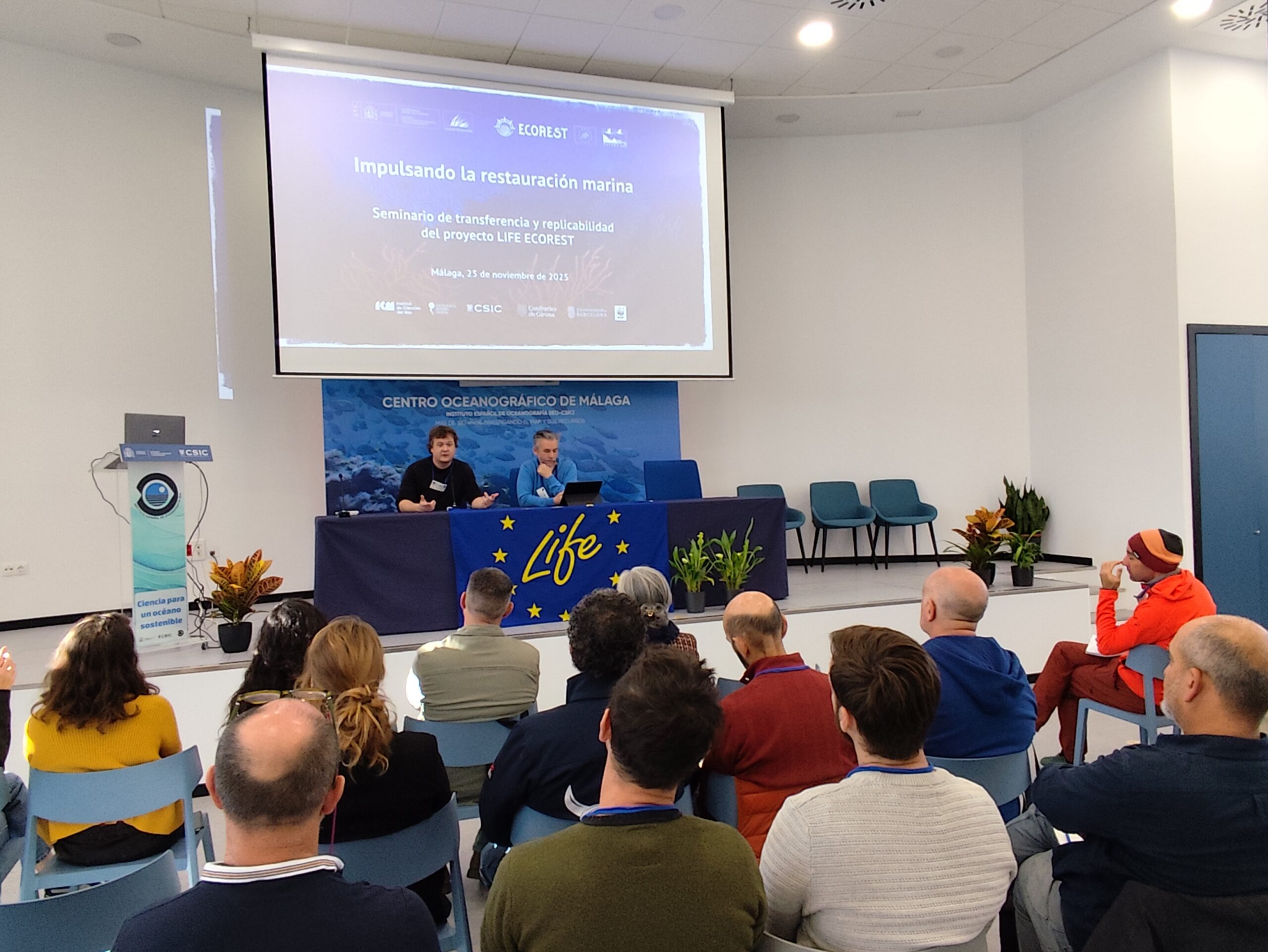
The LIFE ECOREST project, coordinated by the Institute of Marine Sciences (ICM-CSIC), has begun the process of transferring pioneering methodologies and strategies for the restoration of deep-sea habitats applied in Catalonia to other regions of the Mediterranean.
To enhance replicability, the Biodiversity Foundation of the Ministry for Ecological Transition and the Demographic Challenge (MITECO) is organising a series of participatory seminars, in coordination with the project’s partners, aimed at ensuring that the experiences gained within the project can be transferred and replicated in other Mediterranean regions and potentially in other marine contexts facing similar challenges. The initiative also seeks to foster interregional and international collaboration, provide tools and resources, and establish a framework for cooperation.
The first of these seminars, held at the Málaga Oceanographic Center of the Spanish Institute of Oceanography (IEO-CSIC), brought together 30 representatives from the scientific community, isheries, public administrations, and NGOs.
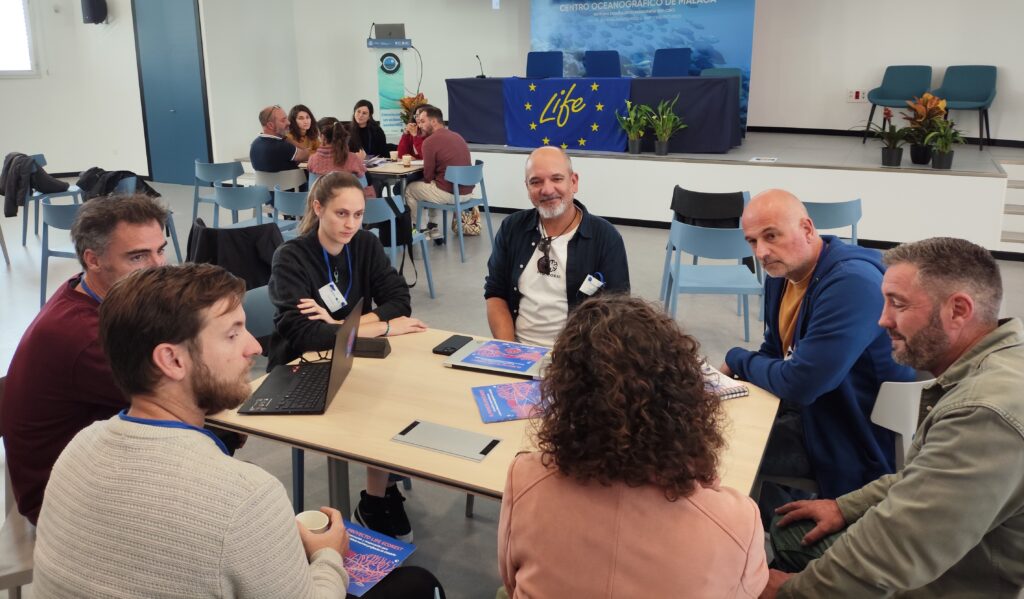 During the meeting, participants emphasized the importance of restoring marine habitats to improve biodiversity and the status of fishery resources, in line with the goals of the Regulation and the National Nature Restoration Plan, presented by MITECO’s Directorate-General for Biodiversity, Forests, and Desertification. By restoring ecosystems such as coral, gorgonian, and sponge grounds, vital habitats are created that serve as feeding, breeding, and sheltering areas for numerous associated species. These habitats not only help connect previously isolated marine populations—promoting genetic flow and resilience—but also facilitate the recovery of threatened species.
The seminar also featured other marine restoration experiences carried out by Soldecocos, the HyT Association, and Coral Soul. Afterwards, participants engaged in group work sessions to analyze technical and scientific aspects, governance issues, sustainability of interventions, and funding sources for replicating LIFE ECOREST strategies in other regions.
The Badminton method
The LIFE ECOREST project is advancing the restoration of nearly 30,000 hectares of deep-sea habitats in Catalonia, in an area of high ecological value along the coastline of Girona and Barcelona, with the active participation of the fisheries sector.
To achieve this, it applies an innovative active restoration methodology known as the “Badminton Method.” Fishers recover corals, gorgonians, and sponges that become trapped in fishing nets and place them in aquariums located in participating fishers’ guilds. When the organisms are in optimal condition, they are prepared to be returned to the sea by attaching them to a cobblestone, which helps them remain upright on the seabed.
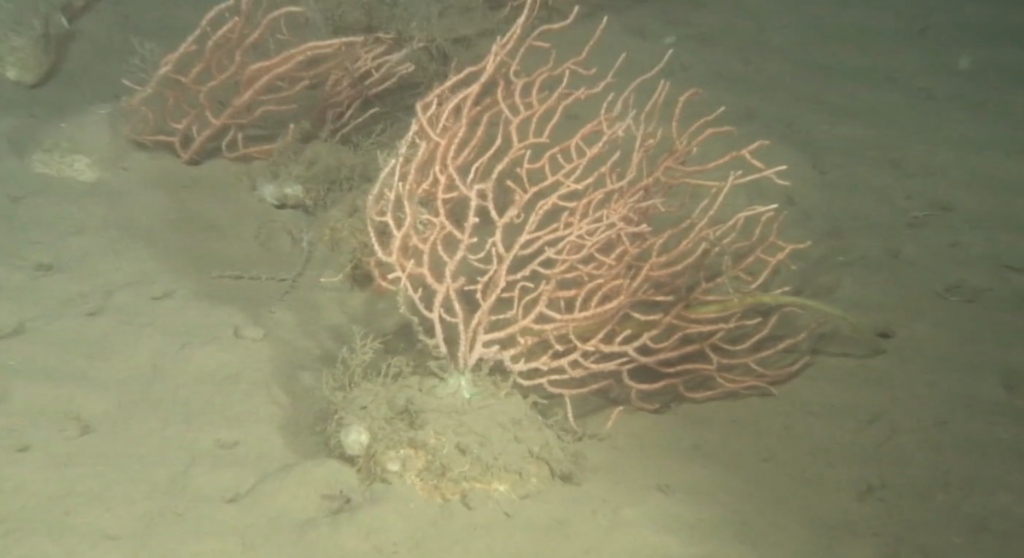 The project promotes the release of many organisms together, fostering the creation of high-density clusters that improve their survival and the recovery of their ecological functions. Thanks to the collaboration of the fisheries sector and the work of the project’s research staff, more than 7,500 organisms have been returned to the sea.
The methodology is easy to apply, cost-effective, and replicable, helping ensure its long-term sustainability—another goal of the LIFE ECOREST project, along with empowering fishers to carry out restoration tasks. It also enables the restoration of larger areas compared to other methods.
Through direct collaboration among the scientific community, the fisheries sector, public administrations, and non-governmental organizations, the project aims not only to restore the biodiversity of the seafloor but also to strengthen the knowledge and management of these valuable ecosystems.
Coordinated by the Institut de Ciències del Mar (ICM-CSIC) until 2026, the project involves key partners, including the Federació Territorial de Confraries de Pescadors de Girona, the Biodiversity Foundation (MITECO), the University of Barcelona, and WWF Spain. It is co-funded by the European Union’s LIFE Programme and benefits from the collaboration of fishermen’s associations in Llançà, Port de la Selva, Cadaqués, Roses, Palamós, Sant Feliu de Guíxols, Blanes, Arenys de Mar, and Vilanova i la Geltrú.