
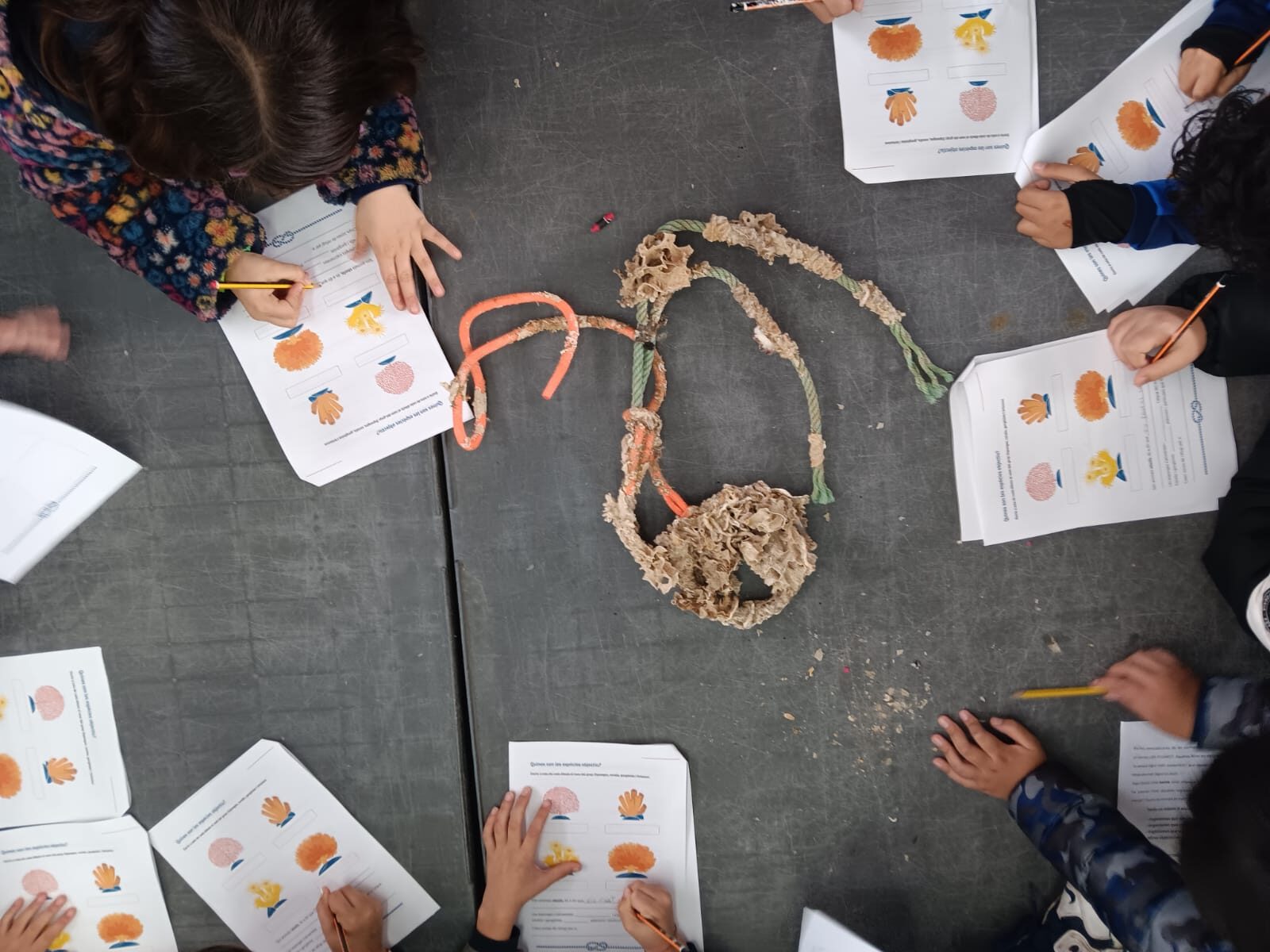
The LIFE ECOREST project has launched a new edition of its environmental education programme, aimed at raising awareness within the educational community about the importance of conserving and restoring deep-sea habitats. The initiative is promoted by Biodiversity Foundation of the Ministry for Ecological Transition and Demographic Challenge (MITECO) in coordination with project partners and led by the Institut de Ciències del Mar (ICM-CSIC).
Over the course of the school year, the programme is expected to reach more than 500 upper primary and secondary school students in the provinces of Girona and Barcelona, in addition to the 450 participants from the previous edition. The activities take place in the towns where fishers’ guilds collaborate in the project.
In this edition, participating teachers will receive online training and an educational guide with interactive materials, games and classroom activities to explore topics related to the marine biodiversity of deep-sea environments, their ecological function and the benefits of their restoration. Some sessions will also be delivered by environmental education specialists. The programme places particular emphasis on sessile species such as corals, gorgonians, sponges and bryozoans, which live attached to the seabed and act as architects of marine habitats, providing shelter and food for many other species.
Visits to the collaborating fishers’ guilds
An important part of the programme takes place outside the classroom, highlighting the role of the fisheries sector in marine conservation and showing how its active participation contributes to the success of restoration actions. Activities include visits to the fishers’ guilds that collaborate with LIFE ECOREST and host the aquariums where accidentally caught organisms are recovered before being returned to the sea.
These visits offer students the opportunity to observe the species involved in the project at close range and to learn about the conservation work carried out in the territory. The first visit of this edition took place at the Arenys de Mar fishers’ guild (Barcelona). In the coming months, schools from Palafrugell, Barcelona, Castelló d’Empúries, Badalona, Vilanova i la Geltrú and Figueres will visit the aquariums located in the participating guilds closest to their schools.
In addition, the educational materials are available on the LIFE ECOREST project website, allowing any interested school to access the content and pedagogical resources.
A collaborative project
The LIFE ECOREST project aims to restore approximately 30,000 hectares of deep-sea habitats in Catalonia through the active involvement of the fishing sector. In addition to research and conservation efforts, the project promotes participatory management, strengthens governance mechanisms, and raises public awareness about the need to protect deep-sea ecosystems.
Coordinated by the Institut de Ciències del Mar (ICM-CSIC) until 2026, the project involves key partners, including the Federació Territorial de Confraries de Pescadors de Girona, the Biodiversity Foundation (MITECO), the University of Barcelona, and WWF Spain. It is co-funded by the European Union’s LIFE Programme and benefits from the collaboration of fishermen’s associations in Llançà, Port de la Selva, Cadaqués, Roses, Palamós, Sant Feliu de Guíxols, Blanes, Arenys de Mar, and Vilanova i la Geltrú.
This edition of the educational programme has also received funding from LIFE INTEMARES.