
With the closing of its second edition, the educational programme of the LIFE Ecorest project comes to an end, reaching more than 1,000 participants who have gained awareness of the value of deep-sea marine ecosystems and the importance of marine restoration. This latest edition has exceeded 572 participants, including students and teachers from primary and secondary schools in Girona and Barcelona.
The programme is promoted by the Biodiversity Foundation of the Ministry for Ecological Transition and the Demographic Challenge (MITECO), in coordination with the rest of the project partners, led by the Institut de Ciències del Mar (ICM-CSIC). This edition has also received financial support from the LIFE INTEMARES project.
Participating schools are located in the municipalities of Barcelona, Badalona, Premià de Mar and Vilanova i la Geltrú (province of Barcelona), as well as Palafrugell, Castelló d’Empúries, Palamós and Figueres (Girona).
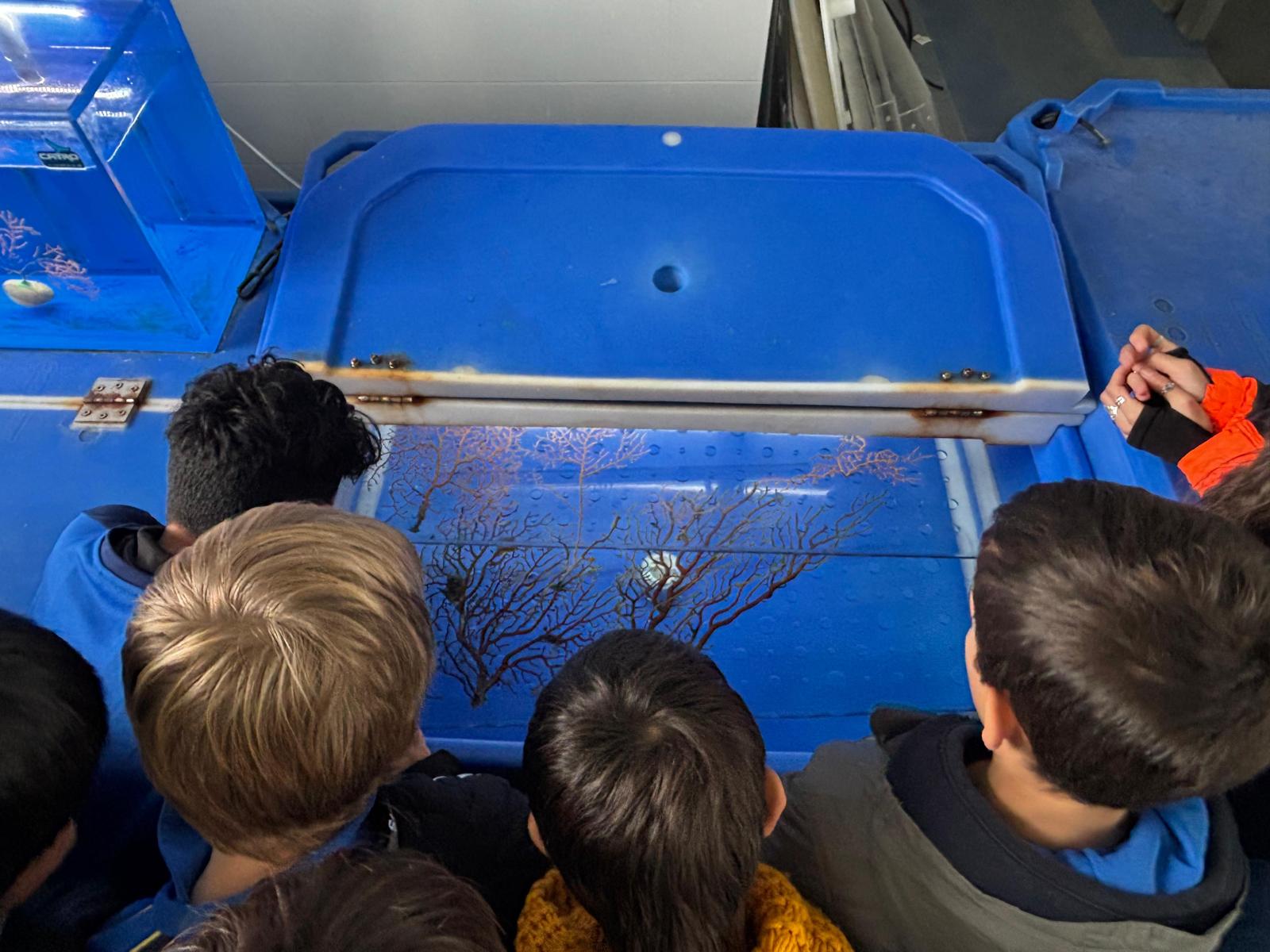
Throughout the programme, 20 sessions were held, combining classroom activities with visits to fisher’s guilds, where corals, gorgonians, sponges and other sessile organisms are kept after being accidentally caught in fishing nets. These organisms are later reintroduced into the marine environment.
Students were thus able to gain first-hand insight into the collaborative work between the scientific community and fishing sectors. The participating guilds that hosted the visits included Palamós, Roses, Llançà and Port de la Selva (Girona), and Arenys de Mar and Vilanova i la Geltrú (Barcelona). Their role has been key in disseminating the project and conveying the importance of marine ecological restoration.
In addition, the programme included specific online sessions for teachers, helping to strengthen their training in marine-related content and facilitating the integration of this knowledge into the classroom.
The programme, which was very well received by participants, has not only promoted scientific knowledge but also supported the development of skills such as teamwork, communication and creativity, while fostering environmental awareness and active participation in marine conservation.
This edition, which began in November 2025 builds on the first edition, which reached more than 450 students from eight schools in the same provinces in 2024. Altogether, both editions have involved more than 1,000 students and teachers, consolidating the LIFE ECOREST educational programme as a key tool for fostering knowledge and commitment among future generations to protect the ocean.
Educational resources and materials are available on the LIFE ECOREST project website for all interested schools.
A collaborative project
The LIFE ECOREST project aims to restore approximately 30,000 hectares of deep-sea habitats in Catalonia through the active involvement of the fishing sector. In addition to research and conservation efforts, the project promotes participatory management, strengthens governance mechanisms, and raises public awareness about the need to protect deep-sea ecosystems.
Coordinated by the Institut de Ciències del Mar (ICM-CSIC) until 2026, the project involves key partners, including the Federació Territorial de Confraries de Pescadors de Girona, the Biodiversity Foundation (MITECO), the University of Barcelona, and WWF Spain. It is co-funded by the European Union’s LIFE Programme and benefits from the collaboration of fishermen’s associations in Llançà, Port de la Selva, Cadaqués, Roses, Palamós, Sant Feliu de Guíxols, Blanes, Arenys de Mar, and Vilanova i la Geltrú.