
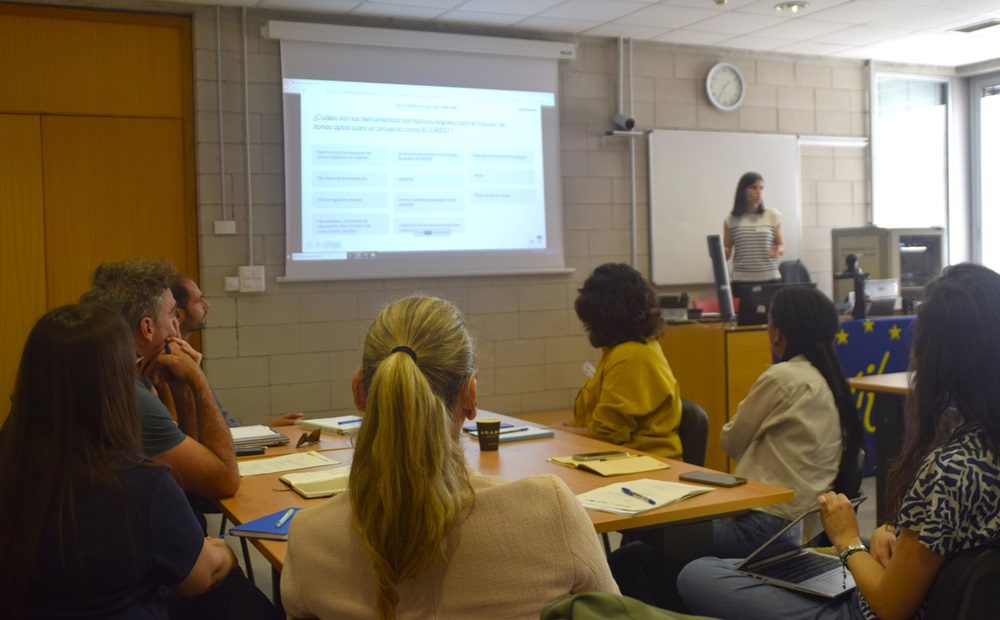
The LIFE ECOREST project, coordinated by the Institute of Marine Sciences (ICM-CSIC), has held the second of its seminars in Palma de Mallorca, aimed at facilitating the implementation of deep-sea habitat restoration strategies in other regions of the Mediterranean.
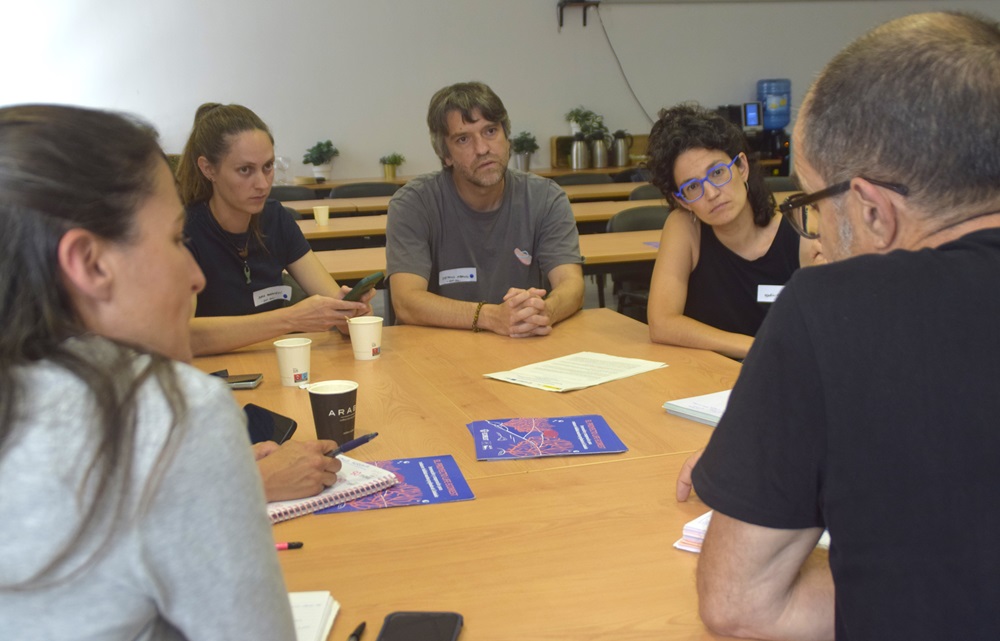
The meeting in the Balearic Islands, promoted by the Biodiversity Foundation of the MITECO, brought together 18 participants from scientific community, public administrations, fisheries and NGOs, who explored how to adapt the project’s methodologies to the specific island context.
 The LIFE ECOREST team has presented techniques for the recovery and reintroduction into the sea of sessile species (coral, gorgonian, and sponges, among others.), organisms that act as ecosystem engineers and are essential for restoring the structural and functional complexity of marine habitats.
These techniques are based on collaboration with the fishing sector and the so-called ‘Badminton Method’. Fishers recover corals, gorgonians, and sponges that become trapped in fishing nets and place them in aquariums located in participating fishers’ guilds. When the organisms are in optimal condition, they are prepared to be returned to the sea by attaching them to a cobblestone, which helps them remain upright on the seabed.
Similarly, the various methods of reintroduction and monitoring employed by the ICM-CSIC using underwater robotic devices were demonstrated, enabling an assessment of the high survival rate achieved. Thanks to the collaboration of the fisheries sector and the work of the project’s research staff, more than 7,500 organisms have been returned to the sea.
The participants examined the conditions required to replicate this model in the Balearic Islands: identifying priority areas for action, available regulatory frameworks, technical and operational requirements, and funding opportunities.
In this regard, the meeting highlighted the importance of restoring marine habitats not only to enhance biodiversity, but also to improve fishery resources, in line with the Regulation and the National Nature Restoration Plan presented by the Directorate-General for Biodiversity, Forests and Desertification of MITECO.
The seminar also showcased initiatives developed in the Balearic region, such as the Cabalga project, which focuses on seabed restoration in the Mediterranean region and Galicia, and the Acció Stellaris project, which focuses on shark recovery, thereby enriching the exchange of knowledge.
The first seminar of the project’s Replication and Transfer programme took place in Málaga in November 2025. The next one will take place in Gijón on 22 July.
The LIFE ECOREST project aims to restore around 30,000 hectares of deep-sea habitats in Catalonia by 2027, in an area of high ecological value along the coast of Girona and Barcelona, with the active involvement of the fishing industry. It involves the University of Barcelona, the Girona Regional Federation of Fisher’s Guilds, the Biodiversity Foundation of the MITECO and WWF Spain, as well as financial support from the European Union’s LIFE programme.